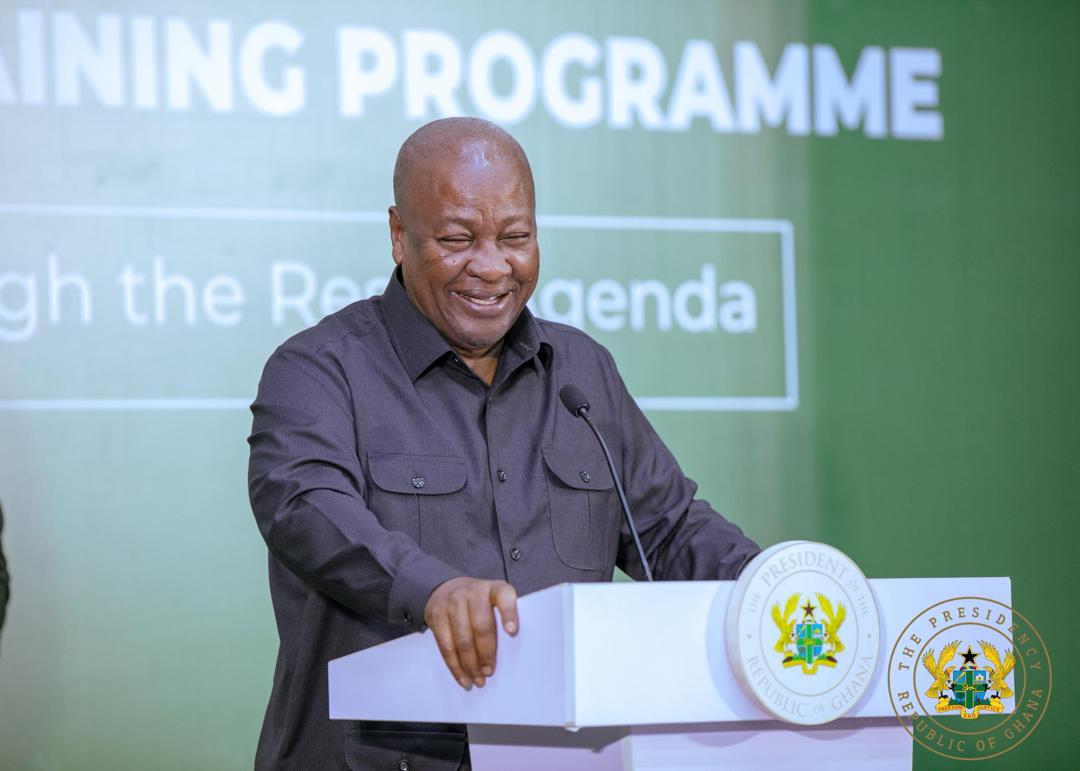
President John Dramani Mahama has announced a landmark shift in Ghana’s local governance system, revealing plans to move from presidential appointments to direct public elections for Metropolitan, Municipal, and District Chief Executives (MMDCEs).
Speaking at the opening of an Orientation Workshop for newly appointed MMDCEs in Accra, President Mahama stated emphatically:
“MMDCEs, you may be the last batch of MDCs appointed.”
He indicated that this change is a cornerstone of efforts under the Reset Agenda to promote participatory governance, transparency, and accountability at the local level.
“Several surveys have shown that Ghanaians prefer to have your category of political access elected, so you may be the last dinosaurs who are appointed,” the President remarked, eliciting laughter and applause from the audience.
Legal Framework Underway
President Mahama assured that the necessary legal and constitutional amendments are actively being pursued through the National Review Committee, which is engaging stakeholders nationwide and is expected to present its final recommendations in August 2025.
“The National Review Committee is going round, and I’m sure some of you would’ve been consulted. One of the major items that has been canvassed is the election of MMDCEs. There’s no doubt that Ghanaians want this change,” he added.
The planned transition aligns with long-standing calls from civil society and governance experts for the depoliticization of local administration and the empowerment of citizens to choose their local leaders.
A Shift in Democratic Practice
If implemented, the reform would mark a significant departure from Ghana’s current governance structure, where MMDCEs are nominated by the President and approved by local assemblies—a process often criticized for promoting political patronage over local development priorities.
Political observers note that the election of MMDCEs could strengthen local democracy, improve performance, and encourage greater citizen engagement in development.
This announcement marks a defining moment in Ghana’s democratic evolution, as the country prepares to hand more power to the people at the grassroots level.