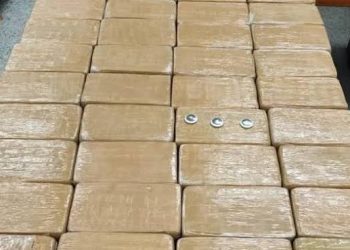
The Ministry of the Interior has defended Ghana’s involvement in the international security operation that led to the seizure of 40 kilogrammes of cocaine in Lebanon, rejecting suggestions that Ghanaian authorities were unaware of the operation or failed to intercept the drugs before they left the country.
Speaking on Radio Gold, Deputy Communications Director of the National Democratic Congress (NDC) and spokesperson for the Ministry of the Interior, Julius Kwame Anthony, maintained that the arrest was the outcome of a coordinated counter-narcotics operation between Ghanaian and Lebanese security agencies.
He accused the New Patriotic Party (NPP) of politicising the operation by questioning why the suspected trafficker was permitted to leave Accra International Airport with the drugs before being arrested in Beirut.
According to him, the operation employed a security strategy known as controlled delivery, under which suspected drug shipments are monitored and allowed to proceed to their destinations to facilitate arrests and expose wider trafficking networks.
Mr Anthony disclosed that cooperation between Ghana and Lebanon began in early 2025, when Lebanese law enforcement officials visited Ghana for discussions on combating transnational narcotics trafficking.
He said the engagement resulted in a memorandum of understanding between the relevant security institutions, followed by a visit to Lebanon by Ghana’s National Security Coordinator.
Explaining the circumstances of the recent seizure, he indicated that the suspect had entered Lebanon from Syria before travelling to Ghana, with Lebanese authorities sharing intelligence on his movements with their Ghanaian counterparts.
He maintained that the suspect’s activities, including his accommodation and movements, were monitored before he departed Accra for Beirut, where he was subsequently arrested.
Mr Anthony cited Lebanese media reports, including a November 1, 2026 publication by Daily Beirut, which he said confirmed that the suspect had been monitored from his departure in Accra until his arrival in Lebanon.
He questioned how Lebanese authorities could have monitored the suspect’s departure from Kotoka International Airport without the knowledge and cooperation of Ghanaian security agencies.
The Interior Ministry spokesperson further rejected suggestions that controlled delivery was an unusual or questionable approach to drug enforcement.
He recalled a previous Ghana–United Kingdom operation involving suspected cocaine traffickers who were permitted to travel to Britain before being arrested at Heathrow Airport in May 2021.
According to him, the international nature of drug trafficking required security agencies to work across borders to identify those involved at both the departure and destination points.
He argued that immediately arresting a suspected courier in Ghana could, depending on the operational objectives, limit investigators’ ability to identify other members of an international trafficking network.
Mr Anthony therefore urged the public to assess the operation within the broader context of international security cooperation rather than political arguments over where the arrest should have occurred.
He maintained that Ghana remained an active participant in the investigation and that the government’s priority was to dismantle trafficking networks exploiting the country as a transit route for narcotics.