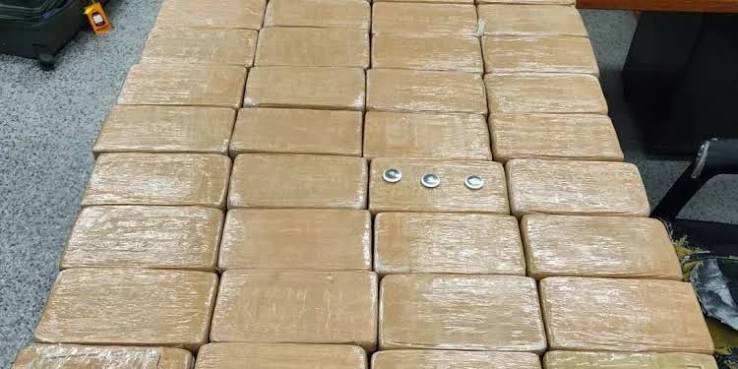
Two suspects arrested in Ghana in connection with the cocaine trafficking operation that led to the seizure of approximately 40 kilogrammes of suspected cocaine in Lebanon remain in custody, as security authorities from both countries prepare to undertake joint interrogations aimed at identifying members of the international criminal network.
Julius Kwame Anthony, Deputy Communications Director of the National Democratic Congress (NDC) and spokesperson for the Ministry of the Interior, disclosed this during an interview on Radio Gold, revealing that three individuals had initially been arrested in Ghana, but one was subsequently questioned and released.
He indicated that the suspects still in custody included a Syrian woman and a Tunisian national, adding that the investigations were focused on identifying collaborators involved in facilitating the movement of the narcotics through Ghana.
Mr Anthony explained that Lebanese security officials were expected to travel to Ghana to participate in the interrogation of suspects, while Ghanaian authorities continued cooperating with investigators handling the arrests in Lebanon.
The investigation follows the October 31, 2026 arrest of a Syrian national at Beirut’s Rafic Hariri International Airport after arriving from Accra with suspected cocaine concealed in two suitcases.
Ghana’s Narcotics Control Commission (NACOC) has described the arrest as the outcome of a coordinated controlled delivery operation involving law enforcement authorities in both countries.
Addressing concerns about Ghana’s continued use as a transit route for narcotics, Mr Anthony acknowledged that the country had long faced challenges associated with international drug trafficking.
He maintained, however, that the government’s performance should be assessed by the measures being implemented to disrupt trafficking networks and strengthen enforcement at the country’s borders.
According to him, the government had expanded the operational presence of the Narcotics Control Commission from seven districts to 77, with plans to extend coverage to approximately two-thirds of Ghana’s districts before the end of the administration.
He also cited improvements in airport security, including the restoration of body and baggage scanners, the deployment of sniffer dogs and stronger inspection procedures.
Mr Anthony further disclosed that courier service operators were now being required to use scanning equipment as part of measures to prevent the movement of illicit substances through Ghana’s transport and logistics systems.
He argued that these interventions demonstrated efforts to strengthen the country’s capacity to detect and prevent narcotics trafficking.
The Interior Ministry spokesperson consequently rejected calls for the removal of officials overseeing the country’s anti-narcotics operations, defending the leadership of the Narcotics Control Commission and Interior Minister Mohammed-Mubarak Muntaka.
He maintained that Ghana’s objective was to eliminate the country’s longstanding reputation as a transit point for cocaine and heroin by expanding enforcement capacity, strengthening border controls and improving international intelligence cooperation.
Mr Anthony stressed that dismantling organised trafficking networks required sustained collaboration with foreign security agencies, particularly where suspected criminals operated across several jurisdictions.
He expressed confidence that the ongoing Ghana–Lebanon investigation would contribute to identifying individuals involved in the shipment and disrupting the wider trafficking network.