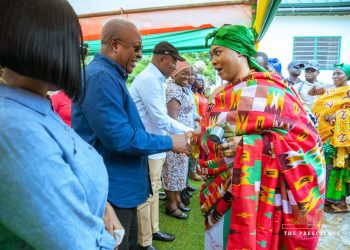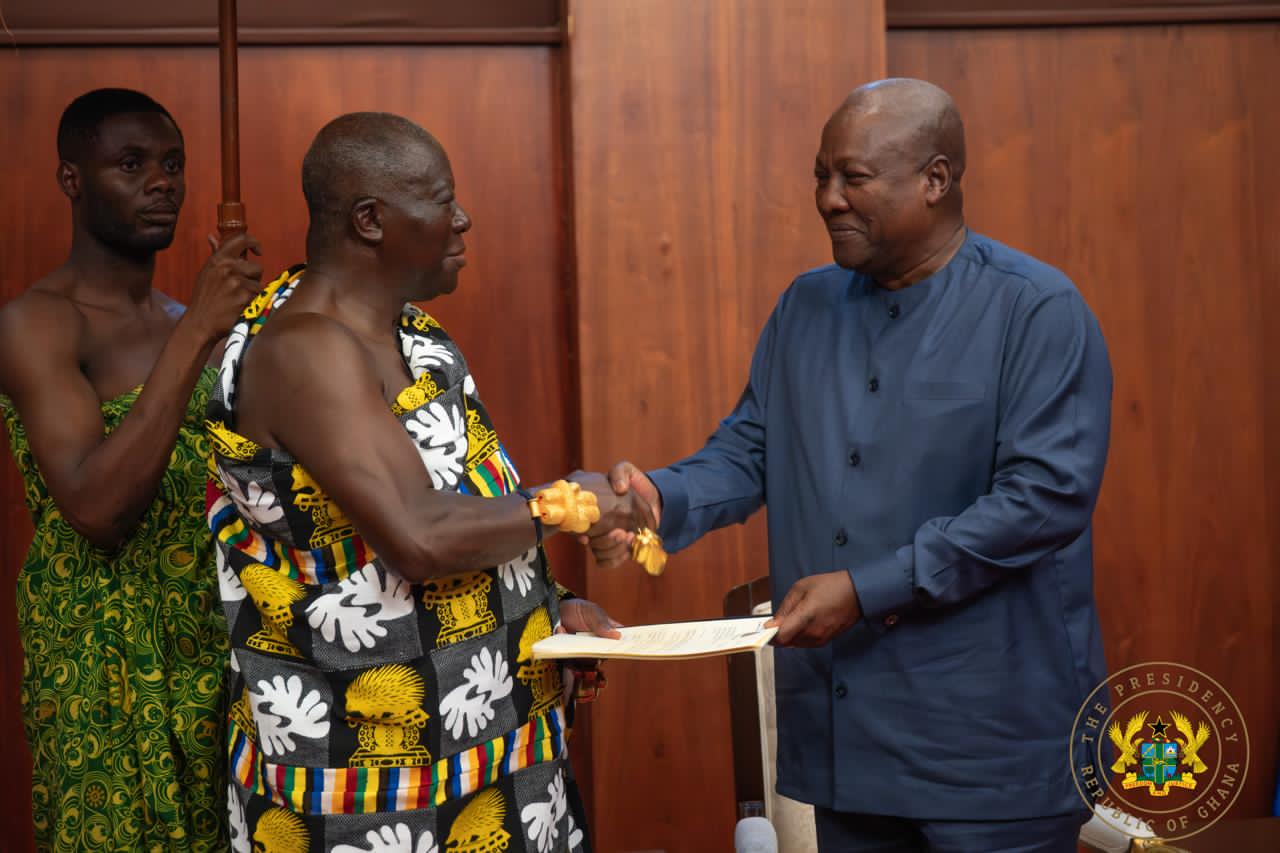
The Asantehene, Otumfuo Osei Tutu II, has formally presented his long-awaited mediation report on the protracted Bawku conflict to the President of the Republic, calling for strict enforcement of existing laws and Supreme Court rulings as the surest path to lasting peace.
Presenting the report at a formal ceremony at the Presidency, Otumfuo said the mediation was undertaken at the request of successive governments and with the full cooperation of the key traditional authorities involved in the conflict.
“By the grace of God, we are able to assemble here this morning to present to Your Excellency the report of the mission entrusted to me,” the Asantehene stated.
“We present the report for your kind consideration and whatever action you and your government consider appropriate.”
A Mediation, Not Arbitration
Otumfuo was emphatic that his role was not to apportion blame but to present facts grounded in history, custom, and law.
“This was a mediation, not an arbitration,” he explained. “I am not here to say this side was wrong or that side was right. I present the facts as they are, and that is what should bind all of us.”
He disclosed that he engaged extensively with both the Nayiri and the Bawku Naba, noting that both parties willingly submitted themselves to the mediation process.
“I have spoken at length with my brother, the Nayiri, and I have consistently engaged the Bawku Naba. Both sides expressed confidence in the process and a desire for an amicable outcome,” he said.
Historical, Legal Journey of the Conflict
Otumfuo traced the Bawku chieftaincy dispute through decades of colonial decisions, post-independence committees, military decrees, and judicial rulings, describing it as “a long, tortuous legal and political journey.”
He noted that repeated court judgments and government interventions failed to bring peace because outcomes were often rejected by parties who felt aggrieved.
“In spite of the efforts of various courts and governments, the conflict persisted, leading to extreme violence, loss of lives, and the destruction of entire communities,” the Asantehene observed.
Supreme Court Finality and the 1992 Constitution
Central to Otumfuo’s recommendations is the position that Ghana’s 1992 Constitution and Supreme Court rulings have already provided legal clarity on the Bawku matter.
“The Supreme Court has shut the doors to any further litigation on this matter,” he stated. “By law and by the Constitution, the Bawku Naba is the lawful chief and paramount authority of the Kusasi traditional area.”
He stressed that traditional authority, no matter how revered, must operate within the framework of the Constitution.
“We chiefs, no matter how exalted, do not live above the Constitution of Ghana,” Otumfuo said. “The laws duly enacted and affirmed by the courts must be respected and enforced.”
Concessions and Call for Reconciliation
Otumfuo revealed that the Nayiri, motivated by a desire for peace, made difficult concessions during the mediation process.
“My brother, the Nayiri, chose the path of conciliation not out of weakness, but as a testament to Mamprugu’s strength, dignity, and commitment to peace,” he said.
However, Otumfuo made it clear that any attempt to undermine the lawful authority of the Bawku Naba would threaten national security.
“There cannot be any rival claimant residing in Bawku holding himself out as chief,” he warned. “The law does not permit it.”
Clear Recommendations to Government
In his final recommendations, Otumfuo urged the government to decisively enforce the law.
“The government must stand firmly with the laws of Ghana and must not tolerate any person challenging the lawful authority of the Bawku Naba,” he said. “This is critical to the restoration and maintenance of peace.”
He concluded by reaffirming his belief that peace in Bawku is achievable if all parties submit to the rule of law.
“If the Supreme Court’s pronouncement is considered unclear, the only remedy lies with the Supreme Court itself,”
Otumfuo stated. “Either way, Bawku and its environs can be assured of sustainable and enduring peace.”
The Asantehene thanked the President, traditional leaders, and community stakeholders for their cooperation and commitment throughout the mediation process, expressing hope that the report would mark a turning point in ending decades of conflict in Bawku.
Story: Patrick Asford Boadu