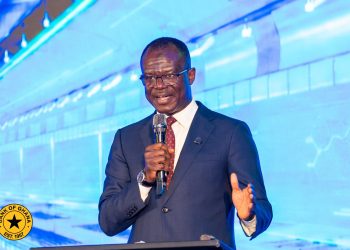
National Democratic Congress (NDC) National Chairmanship aspirant, Dr Akwasi Opong-Fosu, has expressed concern over what he describes as the growing influence of transactional politics in Ghana, warning that the pursuit of personal benefit at the expense of integrity and public interest risks weakening trust between citizens and political leadership.
Speaking in an interview with Sena Nombo on Radio Gold’s Gold Morning Conversation, the former Minister for Local Government and Rural Development said politics must be anchored in service, accountability and a long-term commitment to improving the welfare of citizens rather than reduced to an exchange of material benefits for political support.
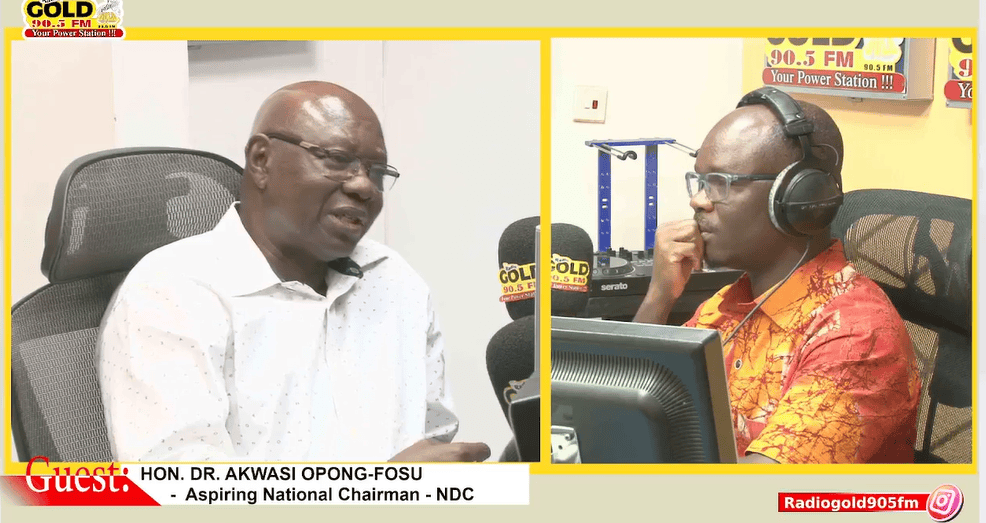
Dr Opong-Fosu drew a distinction between what he described as transactional and transformational leadership, arguing that the former tends to concentrate on immediate personal interests while the latter is driven by a broader and longer-term vision.
He acknowledged that citizens legitimately expect governments and political parties they support to address their needs and create opportunities, but maintained that such expectations should not become the overriding basis for political participation.
“People expect their needs to be met,” he said, citing access to basic necessities, opportunities and security as legitimate expectations of political leadership.
The concern, according to him, arises when political choices are determined principally by the financial resources available to candidates rather than their integrity and commitment to the national interest.
Dr Opong-Fosu said the negative side of transactional politics becomes evident when the question of whether a political figure can be trusted is displaced by considerations about “who has deep pockets.”
He further acknowledged concerns that political participation has increasingly assumed a direct exchange character, where material inducement could influence electoral choices.
Asked whether Ghanaian politics was moving towards a situation in which money could secure votes, the NDC stalwart argued that transactional attitudes had become increasingly visible beyond politics and in wider social relations.
“People have become very transactional in how they relate to their fellow human beings,” he observed, adding that the attitude eventually “translates into politics.”
Dr Opong-Fosu argued that restoring trust requires political leadership to demonstrate transparency, accountability and integrity in public service.
According to him, citizens are more likely to support leaders through difficult periods when they believe those entrusted with public authority are acting transparently and in the wider public interest.
He warned that where these principles are absent and perceptions of cronyism and corruption take hold, the relationship of trust between citizens and leadership is damaged, making effective governance more difficult.
His comments come as he campaigns to become the next National Chairman of the NDC on an agenda centred on “Restoration, Renewal and Reset.” His declared programme includes restoring the party’s foundational values, strengthening its organisational structures and building institutions capable of enduring beyond individual political leaders.