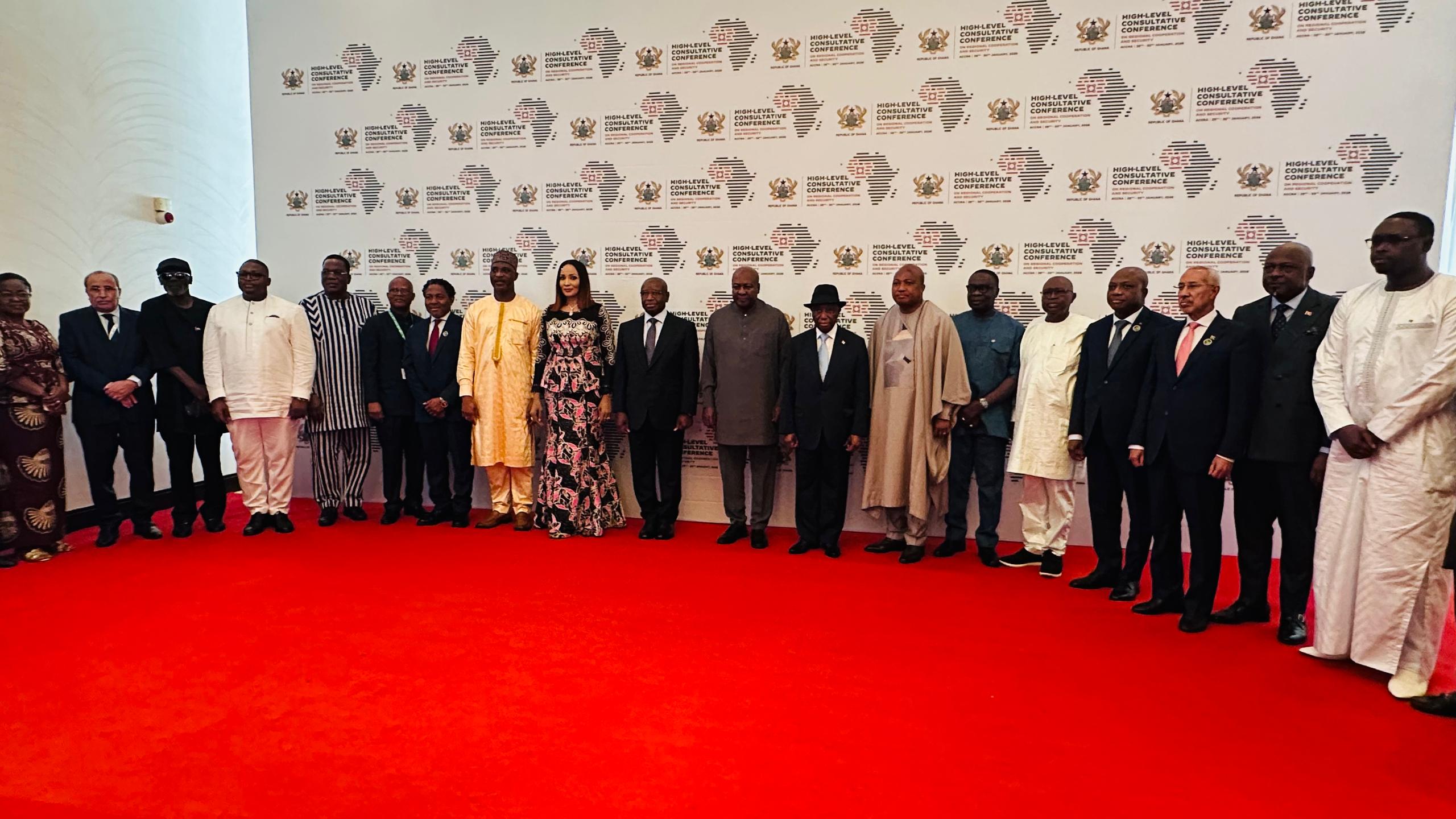
President John Dramani Mahama has issued a clarion call for West African leaders to renew their collective resolve in the face of escalating regional instability. Addressing the High-Level Consultative Conference on Regional Cooperation and Security, the President emphasized that the “existential threat” of terrorism requires a departure from isolated national strategies toward a unified, pragmatic framework of solidarity.
President Mahama opened his address with a candid assessment of the current security landscape. He noted that while the Accra Initiative was established in 2017 to stem the spread of violent extremism, the emergence of the Alliance of Sahel States (AES) and the resulting diplomatic friction have rendered previous cooperation frameworks largely ineffective.
“I am sad to note that the advent of the AES conflagration and the accompanying mistrust that has been engendered between once-cordial sub-regional allies has rendered the Accra Initiative ineffective,” the President remarked. He insisted that despite political differences, the sub-region remains a common home, stating, “The dangers we face from terrorism and violent extremism are a common challenge and a threat to us all.”
Highlighting a recent violent attack in Niger, he expressed Ghana’s unwavering solidarity with its neighbours, insisting that despite political differences, the sub-region remains a “common home” where the safety of one nation is inextricably linked to the stability of all.
Reflecting on his January 2025 mandate for national renewal, the President argued that the principles of institutional honesty and inclusive growth must extend beyond Ghana’s borders, reminding the assembly that the movement of people and goods across shared rivers and transport corridors defines the livelihoods of millions.
“It is therefore neither realistic nor sustainable for any state to pursue peace, security, or prosperity in isolation,” he noted, adding that the destinies of West African states are “inseparably linked by our geography, our history, culture, and our shared human experience.”
The President proposed a paradigm shift in how the region defines security. He argued that modern threats ranging from asymmetric warfare and transnational crime to climate-induced vulnerabilities and youth unemployment, test the limits of traditional state-centric responses.
He further advocated for a more integrated understanding of “human security,” where preventive diplomacy and social resilience take precedence.
Central to this vision is a renewed framework that complements existing ECOWAS and African Union mechanisms rather than replacing them. This strategy, as outlined by the President, prioritizes the integration of security responses with governance and development.
He maintained that development is the ultimate cornerstone of stability, asserting that when young people are empowered through quality education and decent employment, the recruitment efforts of extremist networks are naturally neutralized.
In a direct appeal for accountability, President Mahama stressed that the success of the conference would not be measured by the strength of its declarations, but by tangible improvements in the daily lives of West African citizens. He called for a pragmatic, outcome-driven approach that respects national sovereignty while reinforcing collective responsibility.
Concluding his remarks, President John Dramani Mahama urged his colleagues to choose cooperation over isolation. He characterized the conference as a vital first step in rebuilding trust and shaping a future defined by shared prosperity and constitutional order. With a final call for courage and foresight, President Mahama officially declared the consultative conference open, signalling a new chapter in regional diplomacy.
Eugenia Ewoenam Osei