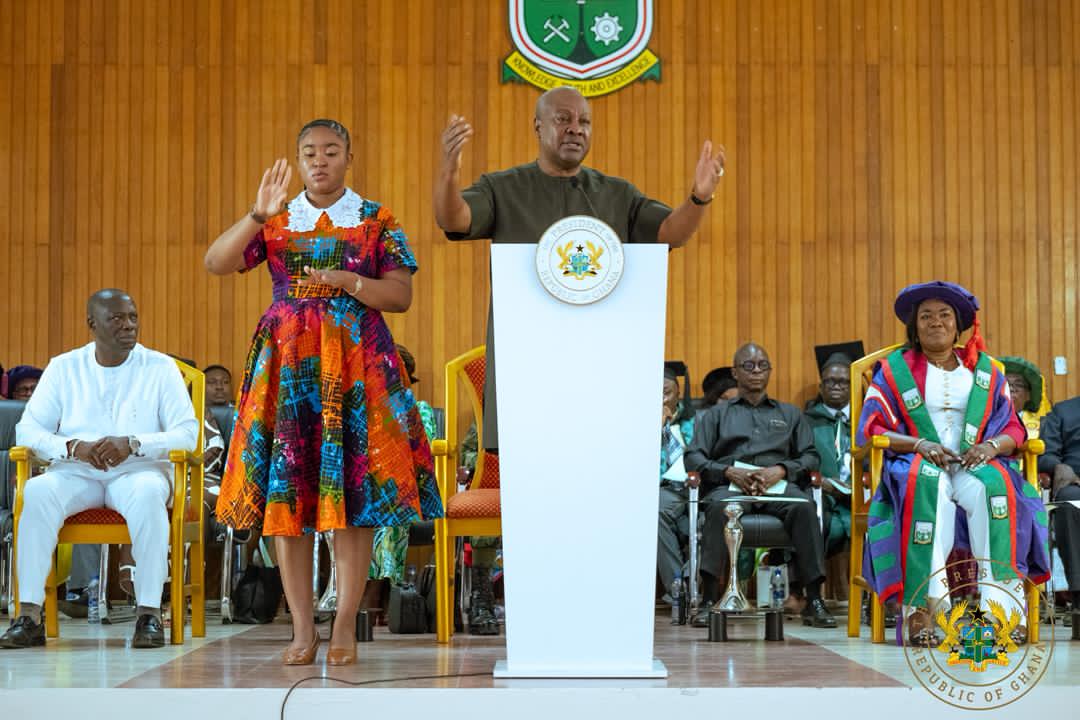
President John Dramani Mahama has underscored the central role of specialised tertiary institutions in Ghana’s industrial future, urging stronger collaboration between government, academia and industry to promote responsible mining, innovation and sustainable development.
Speaking at the Haitian Special Congregation of Embassies of Rights and Technology at the University of Mines and Technology (UMaT), the President described the institution’s mandate as one that “speaks directly to Ghana’s development aspirations, our industrial future and the responsible stewardship of our natural resources.”
Before delivering his main address, President Mahama touched on several issues affecting the mining and tertiary education sectors, beginning with small-scale mining licensing.
“The Chief Executive of the Minerals Commission is here, and I expect that by the time we leave here, a commitment will be made to issue that licence,” the President said, adding that the Minister present should give the necessary directive.
He explained that the licence could be used to create a model small-scale mining operation to serve as a training centre for students and licensed miners.
“It can become a model of small-scale mining, not only for instructional purposes but also to bring licensed miners to learn how responsible mining works,” he noted.
President Mahama also addressed funding challenges affecting the proposed mining museum and research initiatives, explaining that changes in the allocation of mineral royalties had reduced resources available to the Minerals Income Investment Fund.
“We will work to identify alternative funding so that we can complete these projects in the short term,” he assured.
On staffing challenges in public universities, the President acknowledged concerns over delays in financial clearance for the recruitment of lecturers, saying the issue had been brought to the attention of the Minister of Finance.
“For graduate students who aspire to become lecturers, don’t give up. Soon, you will hear some good news,” he said.
Turning to the broader role of tertiary education, President Mahama reaffirmed government’s commitment to education as a cornerstone of national development.
“Education remains the most enduring investment we can make in our people and the shortest pathway to social mobility, innovation and national progress,” he stated.
He explained that government’s tertiary education policy is anchored on three pillars access, quality and relevance highlighting interventions such as the no-guarantor student loan scheme, no-fee-stress for first-year students, free tertiary education for persons with disability, and the Student Loan Plus programme.
“We are determined to ensure that no qualified Ghanaian is denied higher education because of financial hardship or structural exclusion,” the President said.
While expanding access, he stressed that quality and relevance must remain paramount, noting increased government investment in STEM education, technical and vocational training, research, innovation and digital transformation.
“Our universities must produce graduates who are innovative, adaptable, ethically grounded and capable of solving real-world problems,” he emphasized.
President Mahama described specialised institutions such as UMaT as critical to Ghana’s ambitions in mineral value addition, responsible mining, green transition and industrial diversification.
“Government’s ambition in these areas depends heavily on the quality of skills, research and applied knowledge generated by institutions like this,” he said.
On youth empowerment, the President said Ghana’s youthful population would only become a national asset if equipped with relevant skills and entrepreneurial capacity.
“That is why we continue to promote experiential learning, start-up incubation and innovation ecosystems within our tertiary institutions,” he noted, citing programmes such as the Youth Empowerment and Entrepreneurship Programme and the National Entrepreneurship and Innovation Programme.
Addressing illegal mining, President Mahama described it as one of the gravest threats to environmental sustainability, particularly water bodies.
“While enforcement is necessary, the long-term solution lies in knowledge-driven, responsible mining practices,” he said, stressing the role of universities in training professionals and developing environmentally responsible technologies.
A highlight of the ceremony was the recognition of excellence in enterprise, during which President Mahama paid tribute to his younger brother, Ibrahim Mahama, for his contribution to Ghana’s mining and engineering sector.
“I can talk, but money goes farther than talk,” the President remarked humorously, recounting how his brother’s early fascination with machines evolved into the creation of Engineers and Planners, now one of the largest indigenous mining and engineering firms in Africa.
He noted that the company’s success was built on discipline, professionalism and adherence to rules.
“His company has grown not because of political advantage, but because it delivers on time, on budget and according to standards,” the President said.
President Mahama also acknowledged Ibrahim Mahama’s philanthropic contributions, encouraging the university to continue engaging successful entrepreneurs in support of institutional development.
In his closing remarks, the President charged students and graduates of UMaT to see their education as both a privilege and a responsibility.
“Use it not merely to earn a living, but to build your nation. Be bold in innovation, disciplined in conduct and unwavering in service to Ghana,” he urged.
Story: Patrick Asford Boadu